
My Work
Every dress I create carries a story. My work is inspired by the world around me—from the deep teachings of our Ojibwe ancestors and sacred spiritual beings to the vibrant energy of modern culture and music icons. These pieces honor the lineage of the healing dress while pushing the boundaries of contemporary Indigenous fashion.

The Thunderbird Dress
This jingle dress serves as a tribute to the Thunderbird, a significant spiritual being in Ojibwe culture. The Thunderbird is associated with strength, power, and protection, symbolizing the connection between the earth and the sky and representing the forces of nature. It is believed to bring rain, control storms, and act as a guardian for the people, providing guidance and protection during challenging times. In many stories, the Thunderbird is depicted as a powerful creature capable of creating thunder and lightning, showcasing its immense strength and influence over the natural world. This jingle dress is also a personal tribute to my late grandfather, Eddie Benton-Banai. His Ojibwe name, Badwewidan, means "The sound of the thunderbirds approaching." This name signifies that he embodies the spirit of the Thunderbird as a messenger, reinforcing the idea that he carries the essence of this powerful being. Through this dress, I honor both my grandfather's life and the cultural significance of the Thunderbird
The Mishibizhiw Dress

This dress is a tribute to Mishibizhiw, the big water lynx. Ojibwe people revere this spiritual being and consider them the Chief of all water beings. They are considered helpers to Anishinaabeg and we always made offerings to these beings for the gifts they gave us. They are powerful beings and are said to have helped us in wars, helping us win and protecting us. When the thunderbirds and Mishibizhiw fight each other, the blood of Mishibizhiw spills on the ground and stains the ground red. There are copper fragments, their bones, are scattered across the land. Where you find copper, is where the Thunderbirds and Mishibizhiw have been in battle. This dress is a tribute to Mishibizhiw and the protection and leaderships they’ve shown us Anishinaabeg. The dress features Mishibizhiw and real copper Anishinaabe Bimishimo cones, the red velvet fabric representing the blood of Mishibizhiw and birch bark ribbon representing birch bark scrolls. It is my hope that when I dance this dress, it is an echo of the power of copper and Mishibizhiw.
The Healing Dress: Grief

In the heart of this creation lies a story, woven with threads of resilience, compassion, and hope. The Healing Dress, a jingle dress that I crafted for the Survivors Circle for Reproductive Justice, stands as a testament to the experiences of survivors, particularly those who have faced unimaginable loss and trauma of forced sterilization, & have experienced reproductive and obstetric violence. The fabric choice of blue as a representation of grief speaks volumes; it captures the feeling of sorrow while simultaneously embracing the potential for healing. Blue is not just a color; it is the calm after the storm, symbolizing the journey from despair to renewal. The addition of star appliqué is a beautiful tribute to our ancestors, those who have weathered decades of trauma and genocide. These stars serve as a celestial reminder that our ancestors are always present, guiding and supporting us through our struggles. Each star glimmers with the light of their resilience. Through The Healing Dress, I hope to make a space for dialogue, remembrance, and empowerment. It invites those who see it to reflect on their own stories and find solace in the shared experience of grief and healing. In honoring the pain of the past, you have also illuminated a path toward resilience, showcasing the beauty that can emerge from sorrow.
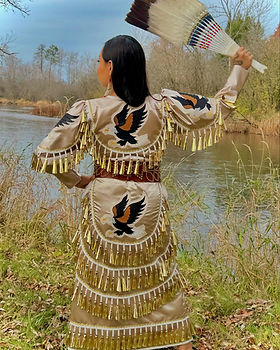
The Eagle Dress
Migizi is one of the most respected beings in creation. One of my favorite stories from my childhood is about a time long ago when the Ojibwe people faced a crisis marked by war, hatred, gossip, and violence. In the midst of this time, the Creator contemplated destroying the world. However, Migizi, the eagle, soared to the Creator's realm, carrying a heartfelt message from the people pleading for mercy. Migizi loves Anishinaabeg so much; To reach the sky world where the Creator resides, Migizi was transformed into animikii, the thunderbird, enabling him to fly close to the sun. Recognizing Migizi's bravery and unwavering truthfulness, the Creator assured him that he would send teachers to help the Ojibwe people. This act solidified Migizi's role as the Creator's messenger and a manifestation of the powerful animikii. Still to this day, Migizi still soars the sky watching over Anishinaabeg, upholding his responsibility. This profound relationship highlights the significance of Migizi in our spiritual practices and connection to the divine.
The 'Water is Life' Dress

The ‘Water is Life’ Dress This dress is a tribute to the legendary Josephine Mandamin, known for her work with water. The water dress is inspired by her dedication to the sacredness of water, a vital source of life. With its bright blue color, the dress mirrors the graceful movement of water, while deeper blues and shimmering silver jingles mimic the depths of oceans and the clarity of lakes. The wavy design symbolize the ripples and continuous flow essential to all ecosystems. This dress not only honors Mandamin's legacy but also serves as a poignant reminder of our responsibility to cherish and protect the water that connects us all. Josephine Mandamin was a dedicated water protector and an advocate for the sacredness of water. She was a beautiful Anishinaabe elder from Wikwemikong. She started “Water Walks” and walked around the Great Lakes and other bodies of water, raising awareness and showing her dedication to the water. She walked over 17,000 miles. Deeply connected to the land, she recognized the vital importance of rivers and lakes, using her voice to raise awareness about water conservation. She taught the world to honor and cherish this precious resource. Her legacy continues to inspire others to protect water. The water, the source of all life.. what sustains us and nurtures us. She is powerful enough to destroy but gentle enough to nurture and protect the unborn. The blood of Mother Earth. In this time of uncertainty and fear in this world, with AI data centers harming our fresh water supply, with leadership of the governments operating with greed and corruption, see this dress as a reminder to practice gratitude in your own life The phrase "Water is Life" encapsulates the deep cultural and spiritual significance of water across many indigenous communities. Movements advocating for water rights highlight the ongoing struggles against pollution and over-extraction, emphasizing the need to protect this precious resource for future generations. As Ojibwe people, we often honor the water in ceremony, the most basic and simple concept of gratitude and appreciation for life.

The Skunk Dress
Zhigaag Jingle Dress Respect for Boundaries: The skunk teaches the value of respecting personal boundaries. Just as the skunk will only spray if it feels threatened, this serves as a reminder to respect others' boundaries and to communicate openly about one’s own. The skunk appears in various stories and teachings within Ojibwe oral history, often imparting lessons about humility, respect, and the consequences of one's actions. These narratives help reinforce community values and wisdom. This dress is meaningful and I put lots of good energy into making it. It comes with a story & I envisioned this dress at a pivotal time in my life.
The Deer Dress

As the hunting season draws to a close for the Lac Courte Oreilles Ojibwe people, we celebrate the beauty of this dress that honors the deer. This dress is a labor of love and respect with many other efforts shared. It came together beautifully, I dreamt of this dress and knew that I wanted to use the natural parts of the deer in some way. This creation embodies the teachings of respect & responsible hunting, emphasizing the importance of using every part of the animal with deep reverence for the life taken. Through offerings of tobacco, we maintain a respectful & intentional relationship with nature. Hunting and gathering have been essential to the survival of the Ojibwe, and the lessons passed down about these practices continue to be vital today. These traditions not only reflect Ojibwe values but also foster love and respect for the beings that sustain us, imparting wisdom and guiding us in being good stewards of the land. Traditional uses of the deer are also used for sacred ceremony (not for public consumption) as well as creating beautiful material items like bags, dresses, beads, etc.Crafted with love and respect, this dress is a beautiful manifestation of shared efforts and dreams. The design features a satin base adorned with deer hide fringe, gold Missouri River jingle cones, and real antler beads. The antlers were traded from Eric Mitchell, an Ojibwe hunter who harvested the deer on our reservation, transforming the dress into a more meaningful piece. The dress showcases natural parts of the deer: the hide & the antlers along with antler appliqué, creating a harmonious display and tribute to this beautiful animal.As an artist, it meant so much to be able to create a tribute dress with natural materials.
The Sweetgrass Dress

The Kindness Dress Satin jingle dress adorned with sweet grass braids and appliqué In Ojibwe culture, sweetgrass is deeply associated with the concept of kindness, both in its symbolism and its practical uses. The plant is often seen as a representation. Sweetgrass is believed to promote harmony and positive relationships among individuals. Its’ use in ceremonies emphasizes the importance of treating others with respect and care. When used in smudging, sweetgrass helps cleanse spaces and people of negativity, fostering an environment where kindness can thrive. Its sweet aroma calls in good spirits, welcoming positive vibes and harmony. The teaching of sweetgrass’s significance often emphasizes the values of kindness, not just in spiritual practices but also in daily life. It serves as a reminder to embody kindness in one's actions, relationships & mindset In our native communities & on our reservations, kindness is the key to changing our futures for generations to come. Our consideration for one another can change the trajectory of lives.
The Morning Star Dress

The Morningstar Dress Celebrating the first snowfall with Venus being visible during the winter months; Venus may be seen in the evening sky shortly after sunset or in the morning sky before sunrise. In Ojibwe star knowledge, Venus—known as Ikwe Anang or the Women's Star—holds profound cultural significance. Its cycle, rising in the East as the Morning Star and setting in the West as the Evening Star, beautifully parallels the nine months of pregnancy, linking Venus to femininity and motherhood. Women would often wake before sunrise to gather water, sharing a special connection with Waaban Anang. Matte satin jingle dress embellished with hand sewn rhinestone trim and rhinestone stars, & cotton underskirt.
The Grandmother Moon Dress

This jingle dress honors Nokomis Giizis, the nurturing grandmother figure in Anishinaabe stories, who watches over by providing light and balance, stabilizing the planet, and regulating tides. Known as "grandmother," she symbolizes wisdom and guidance, reflecting the vital connection between earth and sky. Her presence in creation stories highlights her importance in Anishinaabe culture and spirituality. Grandmother Moon, or Nokomis Giizis, plays a vital role in guiding Ojibwe women through various aspects of their lives. She is seen as a source of wisdom and guidance, helping women connect with their own intuition and nurturing sides. The cycles of the moon are closely linked to women's menstrual cycles, symbolizing fertility, renewal, and the rhythm of life, which can empower women and reinforce their connection to nature. Grandmother Moon is believed to provide wisdom and strength, especially during times of transition and change. Her presence in stories and teachings encourages women to embrace their roles as caregivers and leaders within their families and communities. Overall, Grandmother Moon serves as a symbol of femininity, nurturing, and the deep spiritual connection that Ojibwe women have with the natural world.
The Justice Dress

With every step, hear the sound, Of love, justice, and art all around. From Palestine, with hope we sing, For Black Lives Matter, let freedom ring. For the missing and murdered Indigenous women, We raise our voices, united, never hidden. Every child matters, we stand in their fight, Against food injustices, we seek what is right. As an artist and a creative, I have found myself feeling deeply depressed watching the atrocities of the world unfold. I haven’t been able to create anything new lately. I’m inspired by people who keep pushing forward and who show up on the frontlines.Tonight, my daughter will have a warm dinner, while a child in Palestine will go without. My daughter will get to dance at a powwow, while a child in Gaza cannot because they’ve lost their legs in an airstrike. She will attend school with a full belly, thankfully I can afford groceries, while another parent faces the heartbreaking choice of paying rent over providing food. I can make cherished memories with my daughter, yet many children have been violently separated from their parents due to deportations by ICE agents. A daughter longs for her mother, who has been missing for years.All the children in the world belong to us. As a mother, my heart aches knowing that it could easily be my daughter and I facing these unimaginable challenges. My thoughts go out to everyone affected by genocide, systemic racism, oppression, greed, and corruption. I feel the pain for our communities, including my own, Odaawaazaaga’iganing (Lac Courte Oreilles Ojibwe Reservation), where my people continue to struggle with the effects of colonization and intergenerational trauma.

'Dear America' Ribbon Dress
Dear America No one is illegal on stolen land Your country is built on broken promises and treaties. Indigenous peoples have lived here for thousands of years When I say “No one is illegal on stolen land”, I mean, immigrants who are just trying to survive should not be criminalized for fleeing political persecution, poverty, or violence. Unless you are indigenous, you’re not from here. You came from somewhere else. Your roots are elsewhere. America, your hypocrisy of calling refugees and undocumented peoples is ridiculous. This nation is built on migration & displacement. No one is illegal on stolen land. Which side of history will you stand on?
The Versace inspired dress

The intricate Ojibwe inspired floral patterns I've incorporated carry significance for the Ojibwe people, representing the profound connection to the natural world. We, as Ojibwe people, have always decorated our items, bringing beauty to the everyday. By contrasting these native design elements with Versace's bold, glamorous aesthetic, I'm creating a unique dress that honors the past while also pushing the boundaries of contemporary style. This dress serves as a beautiful testament to the power of creativity to bridge diverse influences. It showcases the adaptability and evolution of indigenous art forms, presenting them in a fresh, modern light. I'm honored to pay homage to my Ojibwe identity while also resonating with today's fashion sensibilities.
The Selena Dress

This is my tribute jingle dress inspired by the Queen of Tejano, Selena Quintanilla. Her signature red glitter, reimagined into a jingle dress. 32 years ago, on May 26th 1993, Selena performed at the "Acapulco Festival" on the beach of the Hotel "El Cano." For this performance, Selena wore her iconic red rhinestone bustier from her Tejano Music Awards outfit that she made earlier that year. She inspired this look, but what’s more is that she designed her outfits for her concerts. Selena and her mother designed and embellished the stage costumes, which often started as basic bras from Victoria’s Secret and were transformed with rhinestones, glitter, and charms. Following in that same spirit of matriarchal creativity, I hand-placed every single rhinestone on this dress. Just as Selena poured her heart into every stitch and stone to claim her space on stage, I’ve beaded my own thoughts into this piece. There is a powerful connection between the shimmer of her rhinestones and the sound of these jingles. Both represent a legacy of femininity and the courage to be seen. Selena’s journey was one of reclaiming her roots—learning her language and embracing her culture even when the world told her she didn't "fit" the mold. That same spirit of reclamation lives in every stitch of this dress. We are moving beyond the boundaries others set for us, stitching together the pieces of our identity into something whole, loud, and beautiful, something I will dance in with love and respect for Selena’s legacy. Because whether it’s on a stage or in the circle, we dance for our ancestors, our future, and for the joy of being unapologetically us.

The Selena Dress pt. 2
This is my tribute jingle dress inspired by the Queen of Tejano, Selena Quintanilla. Her signature glitter and rhinestones, reimagined into a jingle dress. 32 years ago, Selena performed at the "Siempre En Domingo" TV show hosted by Raul Velasco in the city of Monterrey, Nuevo León. This day Selena wore her iconic signature rhinestone bustier that she herself made earlier that year. Funny story: according to her brother, A.B., Selena actually planned to fully bedazzle both cups of this bustier. She ran out of rhinestones halfway through and was initially so frustrated, but she still managed to make it look iconic. I feel incredibly honored to recreate this piece and bring her original vision to life—finishing it exactly how she first imagined. She inspired this look, but what’s more is that she designed her outfits for her concerts. Selena and her mother designed and embellished the stage costumes, which often started as basic bras from Victoria’s Secret and were transformed with rhinestones, glitter, and charms. Following in that same spirit of matriarchal creativity, I hand-placed every single rhinestone on this dress. Just as Selena poured her heart into every stitch and stone to claim her space on stage, I’ve beaded my own thoughts into this piece. There is a powerful connection between the shimmer of her rhinestones and the sound of these jingles. Both represent a legacy of femininity and the courage to be seen. Selena’s journey was one of reclaiming her roots—learning her language and embracing her culture even when the world told her she didn't "fit" the mold. That same spirit of reclamation lives in every stitch of this dress. We are moving beyond the boundaries others set for us, stitching together the pieces of our identity into something whole, loud, and beautiful, something I will dance in with love and respect for Selena’s legacy.
The Nibi Dress
The Nibi Dress This dress is a symbol and reminder to be like water… it may not always flow smoothly but it always moves forward. Growth is like water—flowing, ever-changing, and unstoppable. Just as rivers carve their way through stone, we can overcome obstacles with patience and persistence. Be fluid like water: adapt to challenges, nourish your soul, and rise stronger, just as rain transforms into streams and oceans. Remember, even the smallest ripple can create waves of change in your life. Keep flowing, keep growing.
